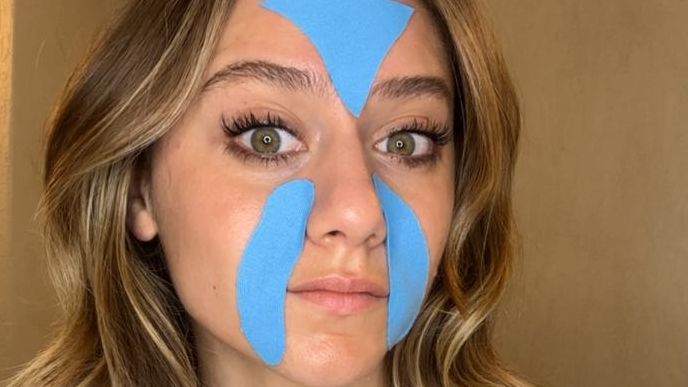
A Celebrity Facialist’s Novel Technique To Soften Frown Lines
- Irritation
- Redness
- Superficial skin injury, in cases when the tape has been repeatedly applied and removed
For these reasons, he says, face taping is best avoided on sensitive or delicate areas of the face – including the eye area. “Anyone with active skin conditions, such as eczema, dermatitis or rosacea, is more likely to experience irritation, so taping should not be used over any affected area.”
Face taping can also trap sweat, oil and bacteria, which may increase the likelihood of breakouts in acne-prone skin – not what you want happening as you sleep. “Although taping is often marketed as a way to relax facial muscles, it doesn’t reliably do so. In some cases, the underlying muscles may actually work against the resistance of the tape, which is unlikely to provide any long-term benefit,” he concludes.
Can face taping encourage lymphatic drainage?
Dr Phillips takes a dim view of face taping as an effective lymphatic drainage (read, de-puffing) aid. In his words: “The evidence is very limited.”
“The lymphatic system sits deeper than the surface layers of the skin, so applying tape can’t meaningfully stimulate lymphatic flow,” he continues. “At most, the tape may create a slight lifting effect that temporarily reduces fluid pooling, but this is minimal and not comparable to proper lymphatic drainage techniques.”
Effective lymphatic drainage, on the other hand, requires gentle, directional massage that follows the natural path and position of the lymphatic vessels. “Tape cannot replicate this process and, if applied with too much tension, can irritate the skin or even worsen swelling.”
How to apply the tape
As well as following Gennari’s lead on Instagram, it’s key to place tape so that it “follows the lymphatic system and muscle structure”. You’ll find some useful diagrams on Google (try typing “face lymphatic system” into the search bar), but some key areas are on the nasolabial folds, the outer corners of the eyes, around the cheekbones and on both sides of the forehead. “It’s very important not to stretch the tape, as it can stress the muscles and do more damage than good,” she adds.
What’s the best tape?
Whether you have sensitive skin or not, the thought of applying tape to your face is not especially appealing. The key to making it comfortable is to ensure you use kinesiology tape for children or for those with sensitive skin. “The glue is gentler and the cotton more breathable,” says Gennari. “I have very sensitive skin. I get mine from Amazon or from specific websites that sell medical tape.” New hack: unlocked.

Sporttape Kinesiology Tape
Face taping vs Botox and injectables
“Face taping sits in a completely different league to anything we would consider clinically effective,” says aesthetic doctor and founder of the eponymous clinic Dr David Jack. “Injectables such as neuromodulators (ie, Botox) soften wrinkles by interrupting the muscle contraction that causes them. Energy-based devices (like the Ziip, NuFace and Sculpta), stimulate real collagen remodelling, and advanced cosmeceutical creams influence cellular behaviour over time. Taping does none of this. At best, it acts as a temporary splint that discourages certain movements for a few hours and may give the illusion of smoother skin while it is physically holding the tissue in place. Once the tape is removed, so is the effect.”
For Dr Jack, face taping can be a useful visual and behavioural reminder not to frown while you’re “answering late-night emails”, but it won’t change anything in a biological sense.